Providers and Community Partners
School-Based Health: Expanding Children’s Access to Health Care
Delaware School-Based Health Centers provide primary prevention and early intervention care.

What is a School-Based Health Center (SBHC)?
School-Based Health Centers (SBHCs) give school-aged youth access to physical, behavioral, and preventive care in school settings.
SBHCs are not a substitute for the student’s primary care provider, but act as a source for referral to outside medical care and as contact points for supportive, comprehensive health services.
Delaware SBHCs serve Delaware’s student populations by:
Providing preventive care Detecting signs of emotional stress and psychosocial problems for counseling and/or referral Facilitating students’ use of health care systems by establishing links with primary health care providers Promoting ongoing comprehensive health care for students of all ages Encouraging parents’ involvement in the health of their adolescents Working toward improving the students’ knowledge of the importance of preventive health care Improving (responsible) decision-making about health matters Reducing risk-taking behaviors Developing health-promoting behaviors Providing early detection of chronic conditions and early diagnosis and treatment of minor and acute illnesses and health problems
School-Based Health Planning Committee
The School-Based Health Planning Committee ensures School-Based Health Centers (SBHCs) are responsive to the individual needs of Delaware’s children.
To help SBHCs increase children’s access to health and wellness services, the Committee has 13 goals in its strategic plan.
The plan will be governed by an independent body from public and private sectors, with a completion target date of 2025.
For more information concerning all SBHCs, contact the Division of Public Health School-Based Health Center Central Office.
These 13 strategic goals are to:
Create an advisory body to oversee the Delaware SBHC strategic plan and make recommendations. Encourage new sites where the need is greatest. Allow siblings to enroll. Encourage hub-and-spoke model to deliver care. Develop data collection and analysis infrastructure. Establish a base service menu model. Ensure approaches to care are aligned and comprehensive across all SBHC sites. Ensure a continuum of care through collaboration with primary care and other community providers. Ensure telehealth services continue. Increase funding to cover the cost of non-billable services. Increase efficiencies to allow SBHCs to be credentialed as an approved service provider to seek third-party reimbursement. Explore creative solutions with commercial payers. Maximize third-party billing.
Our new School-Based Health Center Strategic Plan is here!
Strategic Planning Steering Committee
These are the individuals through their participation in the committee contributed to the development of the SBHC Strategic Plan.
Dr. Jon Cooper
Vice-Chair
Director, Division of Behavioral Health — Colonial School District
Dr. Aileen Fink
Vice-Chair
Behavioral Health Administrator, Department of Services for Children, Youth & Their Families
Leah Woodall, MPA
Section Chief, Family Health Systems, Delaware Division of Public Health
Kristin Dwyer
Director of Legislation and Political Organizing, Delaware State Education Association
Christine Visher
Director, Center for Drug and Alcohol Studies, University of Delaware
Christina Crooks Bryan
Director, Communications and Policy, Delaware Healthcare Association
Forrest Watson III, BS, MBA
Founder & CEO / Executive Director, Life Health Center
D. Patches Hill
Director & CIO, Delaware Department of Education
Yvette Santiago
President, Board of Education, New Castle County Vo-Tech School District
Midge Barrett
Executive Director, SBHC Alliance
Catherine O’Neill, LCSW
Beebe School-Based Health Center, Lic. Clinical Social Worker, Indian River HS
Amy Burnett, FNP-C
Bayhealth School Wellness Center, Center Coordinator (Smyrna High School)
Rochelle Lazorchak
Social Services County Operations Manager
Dr. Liz Brown
Medical Director, Delaware Division of Medicaid and Medical Assistance
Kimberly Robinson, Esq.
Director, State Regulatory & Government Affairs, Cigna Corp.
Susan Haberstroh
Director, School Support Services, Delaware Department of Education
Dr. Priscilla Mpasi, MD, FAAP, Pediatrician
Pediatrician-Pedriatrics Specialist
Dr. Harry Lehman III, MD
Pediatric Services, Nanticoke Memorial Hospital
Rosa Rivera
Operations Officer, La Red Health Center
Kathy Cannatelli
Director, Center for Community Health, Christiana Care Health System
Dr. John Marinucci
Executive Director, Delaware School Boards Association
Fran Russo-Avena, RN, MSN, MSM
Delaware Technical & Community College
Delaware Division of Public Health Staff
Dr. Gloria James
Chief Bureau of Adolescent and Reproductive Health
Cassandra Davis, MSM
Director of Adolescent Health
FAQs
Learn more about these services that provide physical, behavioral, and preventive care in school settings — including how to find a location in your community.
Please click the following link to view these regulations: 18 Del. C. §3365 and §3571G
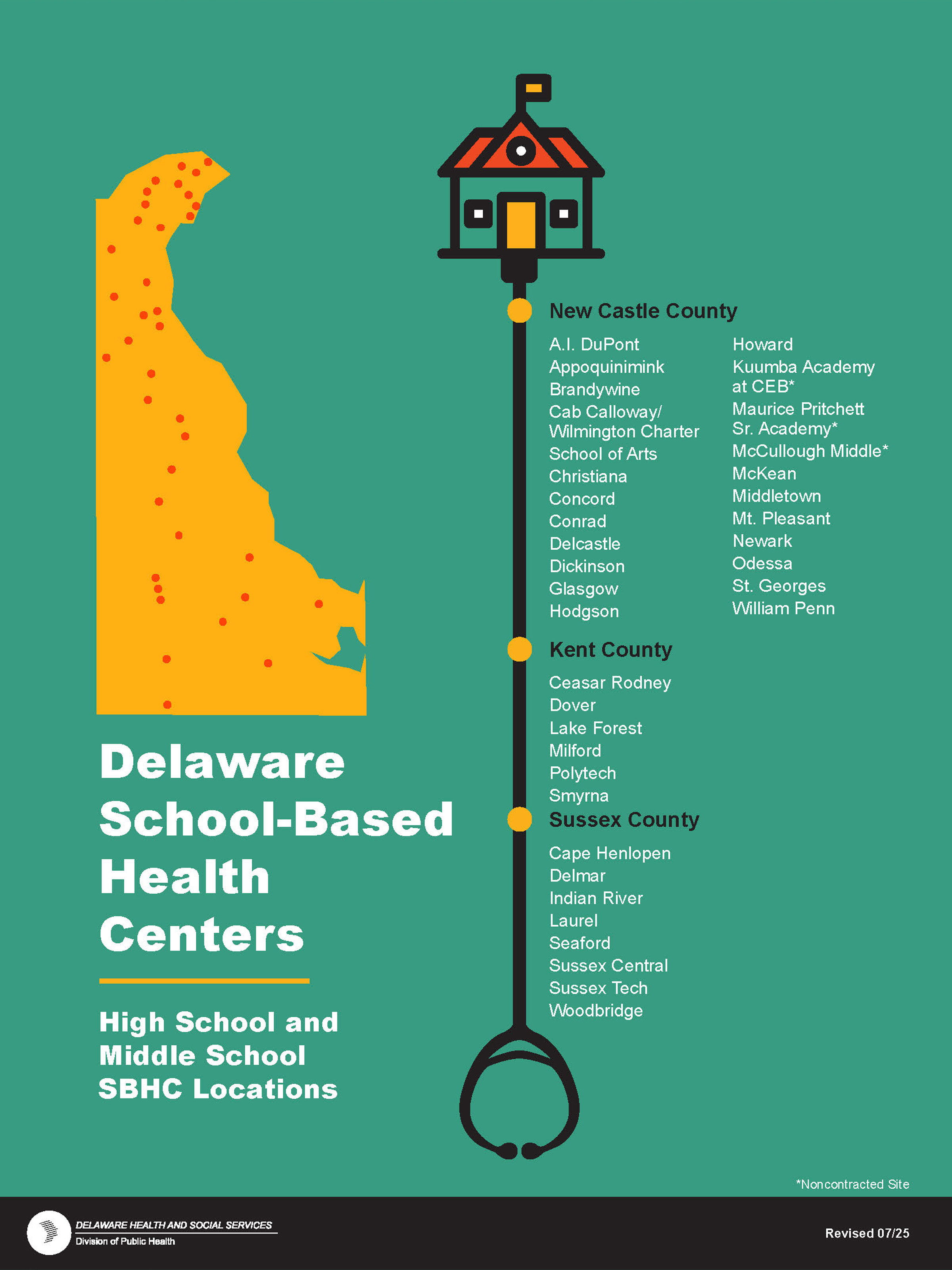
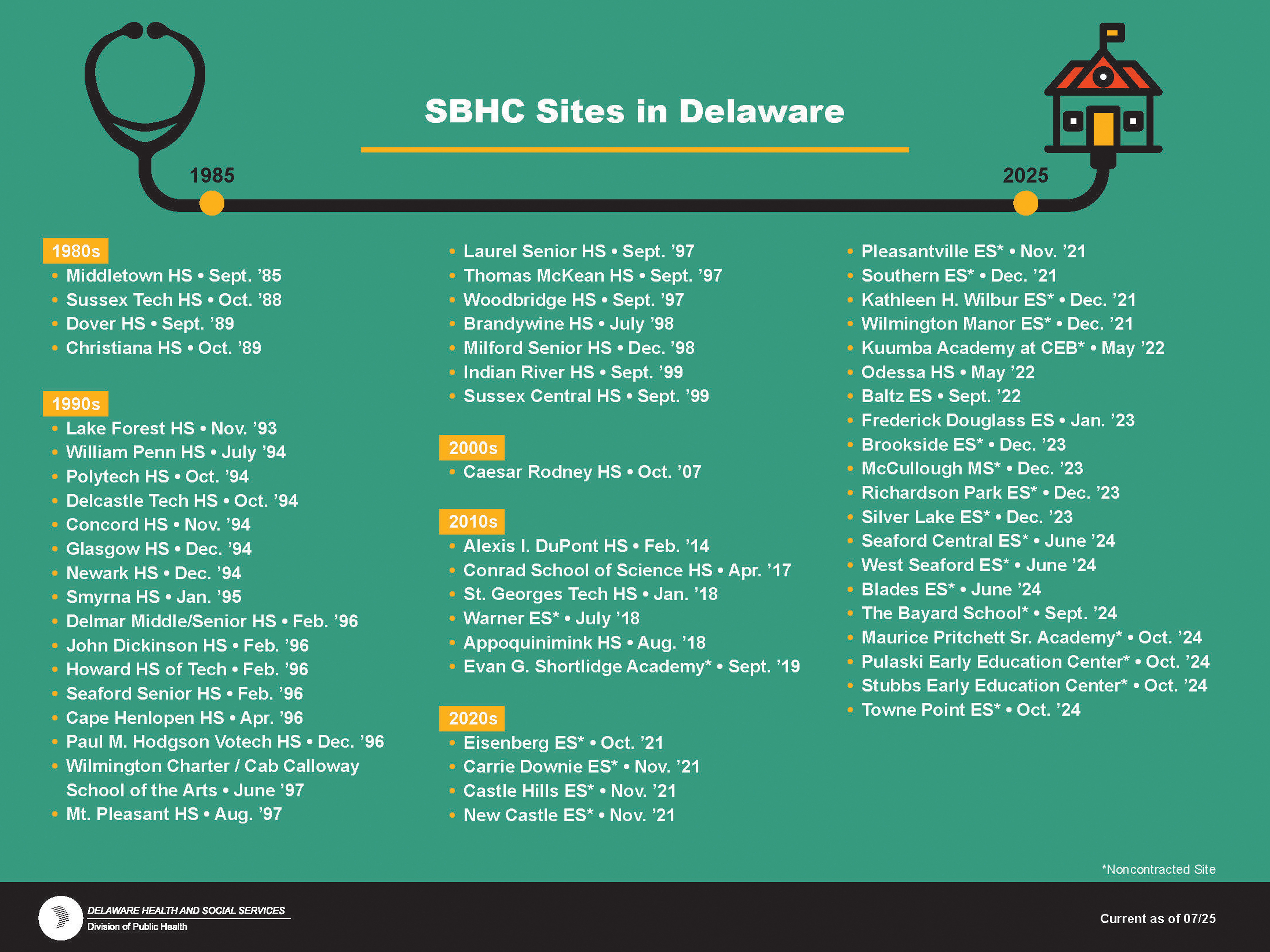
School-based health centers (SBHCs) have existed in Delaware since the 1980s and have expanded to 39 sites, with one in every public, non-charter high school. SBHCs, also referred to as school-based wellness centers or student wellness centers, are a type of health care delivery model that provides school-aged youth with comprehensive physical, behavioral, and preventive health services delivered by qualified medical and behavioral health providers in school settings.
Delaware’s SBHCs are operated by multi-disciplinary teams of health professionals who use a holistic approach to address a broad range of health and health-related needs of students.
Click here
Click here
Dr. Priscilla Mpasi, a local pediatrician and SBHC Strategic Planning Committee member offers insight into SBHCs from a medical provider and pediatric specialists perspective here
Click here
Division of Public Health (DPH) - Contracted, State-Funded SBHCs:
- The school district approaches DPH with the desire to establish a SBHC.
- DPH releases an equal opportunity Request for Proposals (RFP) for medical sponsors to bid on contracting.
- A medical sponsor is selected and contracts with DPH to receive state funds and ensures policies and procedures are consistent with DPH regulations.
- Medical sponsors contract with school districts on SBHC operations and agreements.
- DPH recognizes and regulates SBHC to allow for SBHC to negotiate and seek Medicaid reimbursement.
Non-Contracted, State-Funded SBHCs:
- The school district receives state funding to establish an SBHC.
- The school district releases an equal opportunity Request for Proposals (RFP) for medical sponsors to bid on contracting.
- A medical sponsor is selected and contracts with the school district to receive state funds.
- DPH recognizes and regulates SBHC to allow for SBHC to receive Medicaid reimbursement.
Non-Contracted, Non-State Funded SBHCs:
- The school district approaches a medical sponsor to establish a SBHC in the school.
- Medical sponsors contract with school districts on SBHC operations and agreements but does not receive state funds.
- DPH recognizes and regulates the SBHC to allow for SBHC to receive Medicaid reimbursement, but does not supply state funds.
Application Process to Become a State Recognized School-Based Health Provider
Organizations that will be providing School-Based Health Center Services under a contract with the Division of Public Health:
Delaware SBHCs are funded through a combination of state funds, Medicaid reimbursement, and reimbursement from commercial insurance, but also rely on community partnerships and in-kind support from schools and medical sponsors. More information is provided in the School-Based Health Center Strategic Plan which can be viewed here
For more information on the School-Based Health Center Strategic Plan process from Dr. Jon Cooper, click here
- Designated waiting/reception area and at least one exam room.
- At least one sink that runs hot and cold water.
- Counseling room/private area.
- Toilet facility with a sink that runs hot and cold water.
- Office/clerical area.
- Secure storage area for supplies and medications.
- Designated lab space with sink and hot water.
- Secure and confidential storage areas.
- Phone line exclusively dedicated for the SBHC.
Yes, below lists a suggested model, measured in square feet, for a hub and spoke.
Hub: Converted classroom, minimum 900 square ft.
- 2 exam rooms (with the ability for a mobile dental unit) – 100 square ft. each
- Waiting/reception area – 200 square ft.
- Bathroom – 100 square ft.
- Counseling room – 150 square ft.
- Prep area/wet space (only needed if exam rooms do not have a sink and running water) – 100 square.
- Medical office – 100 square ft.
- Storage (records, medication, immunizations, may require refrigeration) – 50 square ft.
- Secure external and internal entrances
Spoke: Designated space for SBHC, minimum 400 square ft.
- Exam room (with sink and running water) – 100 square ft.
- Storage area (records, medication, immunizations, may require refrigeration) – 50 square ft.
- Waiting area – 200 square ft.
- Bathroom (if possible, could share with nurse’s office) – 100 square ft.
SBHCs are recommended to be Joint Commission compliant.
Per the Delaware Code SBHC’s must provide:
- Preventive cares such as Sports or workplace physicals.
- Diagnosis and treatment of minor acute care.
- Immunizations.
- Reproductive health for middle and high school with school board approval (Sexually Transmitted Infections and HIV testing, contraceptives, pregnancy testing, birth control pills).
- Behavioral health (individual and group counseling, substance use screening for middle and high school).
- Crisis intervention.
- Nutrition counseling.
- Health education.
- Referrals and connections to primary care, specialty care, oral health care, and behavioral health care.
- Other – Dental/Oral Health Assessment of Needs.
SBHCs can serve as an innovative health care delivery model proven to enhance population health and reduce long-term health care costs. From national studies, SBHCs have a documented positive impact on students’ physical and behavioral health. A 2016 systematic review of 46 studies on SBHCs impact on academic and health outcome across SBHCs in K-12 schools catalogues this impact:
- A median reduction of 51.6% in non-asthma-related hospitalizations. A median reduction of 40.0% in teen pregnancy among females⁵.
- A median reduction of 5.7% in self-reported mental health problems.
- A median reduction of 15.7% in any reported substance use (including tobacco and alcohol). Primary care and behavioral health care delivered in SBHCs also helped to reduce disparities in health care access, utilization, and costs, as well as health outcomes, for racial and ethnic minority populations, even more so than care received in other clinical settings. One 2016 review of SBHC approaches by the Brookings Institute reported that students were 10 times more likely to utilize SBHC services for behavioral health needs than other clinical sites or community health centers. SBHCs are also associated with substantial education benefits, including reductions in rates of school suspension and high school non-completion and increases in grade point average and grade promotion. Behavioral health services offered through SBHCs are credited with reducing violent student behaviors and absenteeism and improving school achievement, attention, and social skills. Additionally, easy and close access to physical and behavioral health services through SBHCs has improved more proximal educational measures, such as student seat time. With a focus on primary and preventive care, SBHCs have significant cost benefits. One 2016 systematic review of 22 studies found that that SBHCs have a total net savings to Medicaid ranging from $30 to $969 per visit and $49 to $1,166 per student.
- A different systematic review of 46 studies estimated total annual savings from SBHCs to be $15,028 to $912,878 for communities due to reductions in emergency visits and other healthcare utilization. The financial impact of SBHCs was found to be particularly strong in underserved communities, given SBHCs unique impact on health disparities, with one study estimating a net social benefit of $1.35 million over three years.
Source:
4 18 Del. C. §§3571G. 5
Helpful SBHC Documents for Professionals
Below are resources that can help.